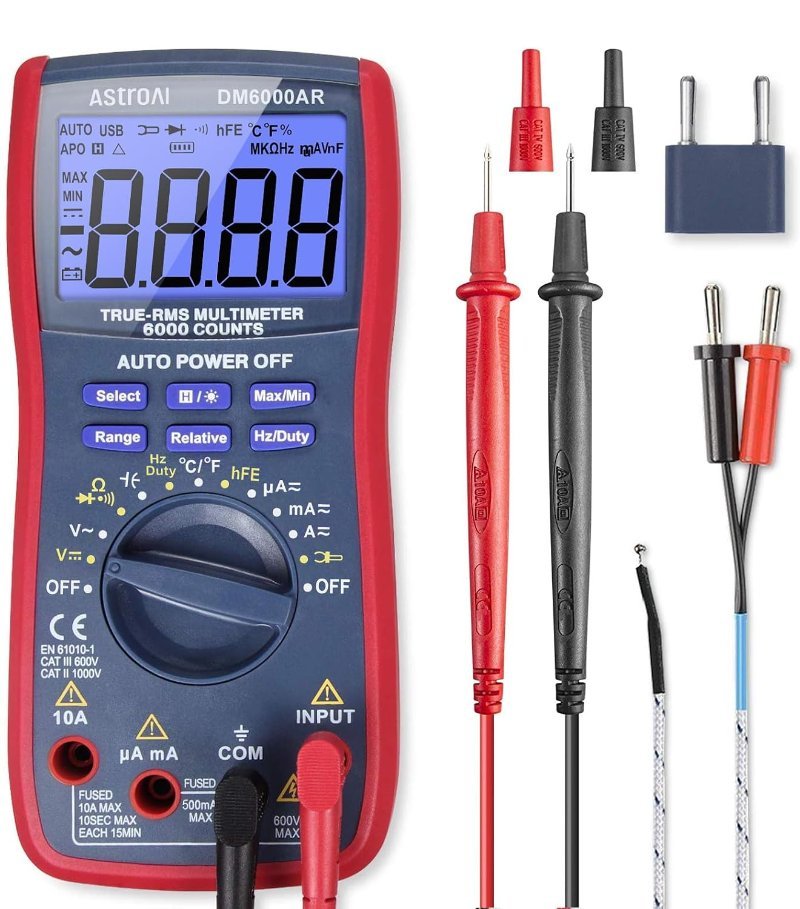
A multimeter is the single most useful tool on an electronics bench, and it is also the one people most reliably overspend or underspend on. Buy a $6 no-name meter and you will spend an afternoon chasing a bug that turns out to be your meter reading 4.2V on a 5V rail. Buy a $300 Fluke for Arduino work and you have bought a lifetime-warrantied instrument to measure LED forward voltages.
I have used all three of the meters below for hobby-scale work — breadboards, robot chassis wiring, battery packs, the occasional wall wart. Here is what actually separates them, and which one I would hand a beginner.
The four specs that actually matter (and the ones that don’t)
Count resolution. “6000 counts” means the display can show numbers up to 6000 before it has to switch ranges — so it reads 5.999V, not 5.99V. A cheap 2000-count meter jumps to a coarser range sooner and loses a decimal place exactly where you need it. On a 5V rail, that extra digit is the difference between “close enough” and knowing your regulator is sagging.
True RMS. RMS (root mean square) is the math that converts a wiggling AC waveform into the equivalent steady DC value. A cheap “average responding” meter assumes every AC signal is a clean sine wave and applies a fixed fudge factor. Feed it anything choppy — a PWM signal, a switching supply, a dimmer circuit — and it lies. True RMS meters actually compute the value. For pure Arduino DC work you will rarely care; the moment you measure anything off a switching converter, you will.
Continuity beep speed. Underrated. Continuity mode beeps when two probe points are electrically connected, and you use it constantly to trace whether a breadboard row is really joined to the pin you think it is. A meter with a lazy 300ms beep makes you hold each probe still; a fast one lets you drag a probe across a row of pins and hear the connections. This is a quality-of-life spec that no listing advertises.
A fused 10A current input. Measuring current means breaking the circuit and putting the meter in series, which is exactly how people blow up meters — probe still in the amps jack, then touch it across a voltage source, and you have created a dead short through your multimeter. A proper fuse turns that mistake into a 50-cent replacement instead of a dead meter or a burn.
What doesn’t matter much for hobby work: transistor hFE sockets (a novelty), a thermocouple you will use twice, and — controversially — CAT ratings. CAT III/IV ratings describe survivability against transient spikes in building wiring. If your meter never leaves the bench and never touches anything above a 12V battery, the rating is insurance you are not cashing in. It becomes real the moment you probe a wall outlet or a mains-powered supply, so don’t dismiss it entirely.
The picks
This post contains affiliate links. If you buy through them, this site earns a commission at no extra cost to you.
Best for most hobbyists: AstroAI True RMS 6000
This is the meter I would put in front of someone building their first robot. It hits every spec above — 6000 counts, genuine True RMS, auto-ranging, a fused 10A input, CAT III 600V — at a price where losing it in a move is annoying rather than painful. Auto-ranging matters more than beginners expect: instead of guessing whether a reading will land in the 2V or 20V range, you turn the dial to DCV and probe. The meter figures it out. Capacitance and temperature are along for the ride, and the continuity beep is quick enough to drag-test a breadboard row. It is not a precision instrument — the basic DC accuracy is roughly ±0.5%, which is fine for verifying a rail and useless for calibrating anything — but nothing at this price is.
True RMS, auto-ranging, fused 10A input, CAT III 600V. The default answer for Arduino and robotics work.
Check Price on Amazon →The upgrade that’s actually worth it: KAIWEETS HT118A
The HT118A is the meter for someone whose projects have started leaving the breadboard. Same 6000-count True RMS core, but with a bigger 2.9-inch backlit display, a CAT III 1000V / CAT IV 600V rating, and a non-contact voltage detector that lights and beeps near live AC without touching anything. It measures to 1000V DC and 750V AC, 10A current, and 60 MΩ resistance. The backlight sounds like a gimmick until you are lying under a robot chassis in bad light. If you expect to probe anything mains-adjacent — a power supply teardown, a project box with a wall transformer inside — the higher CAT rating stops being theoretical.
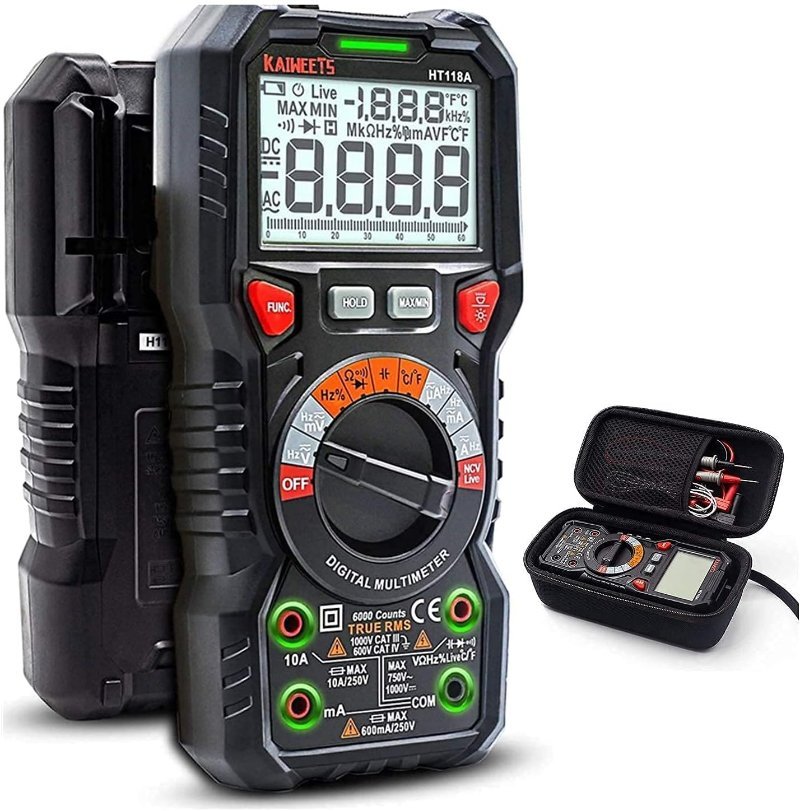
6000-count True RMS with a large backlit display, CAT III 1000V / CAT IV 600V, and non-contact voltage detection.
Check Price on Amazon →The one with a caveat: Fluke 101
The Fluke 101 is real Fluke build quality in a pocket body, and it is genuinely tougher than anything else here — people have abused these badly and kept using them. But read the spec sheet before you buy it: it does not measure current at all. Voltage, resistance, continuity, capacitance, and frequency only. For an electrician checking whether a circuit is live, that is fine. For a hobbyist, “how much current is my project actually drawing?” is one of the top three questions you will ask a meter, and this one cannot answer it. Buy it if you want a bombproof pocket voltage checker to live in a toolbag alongside a bench meter. Do not buy it as your only meter.
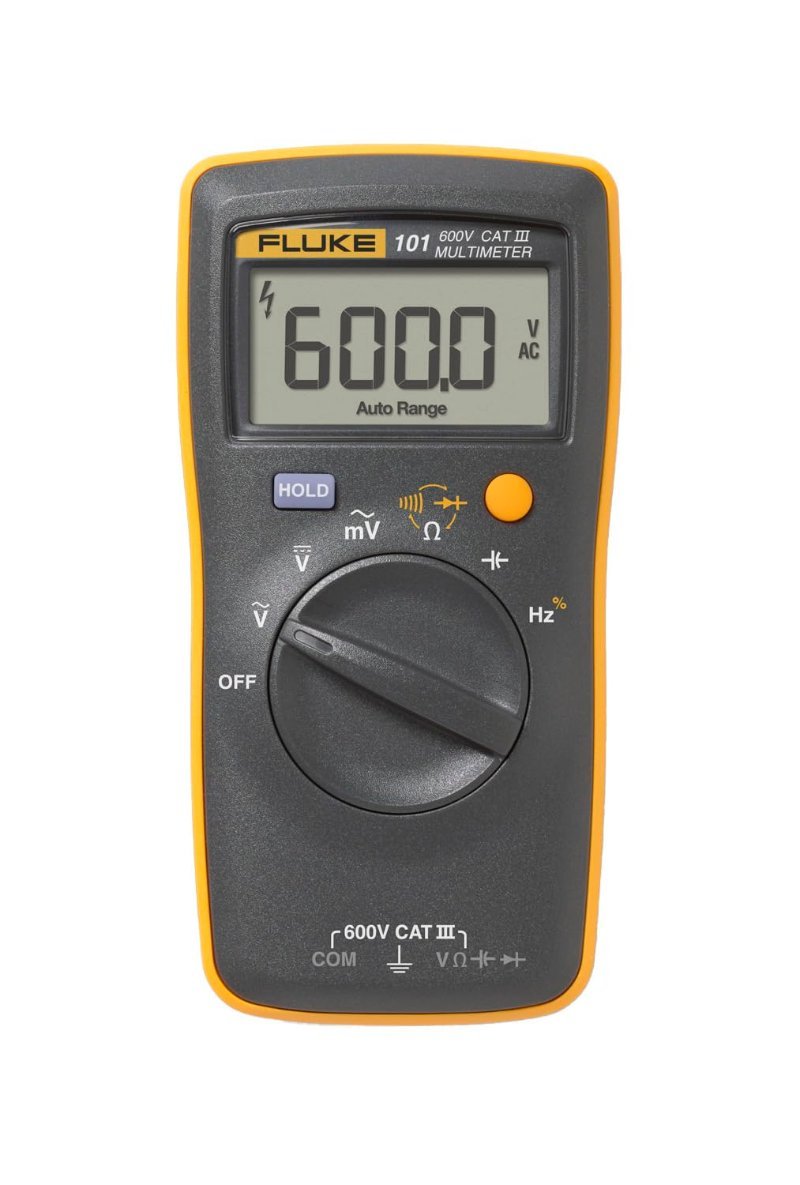
Fluke build quality in a pocket meter — but no current measurement at all. A second meter, not a first one.
Check Price on Amazon →The verdict
Get the AstroAI. It does everything an Arduino or robotics project will ask of it, it measures current, and it costs less than a decent sensor kit. Step up to the HT118A if you want the bigger display and the mains-grade safety rating. The Fluke 101 is a good meter solving a problem hobbyists don’t have.
Whichever you buy, the habit that matters more than the meter: put the red probe back in the volts jack every single time you finish a current measurement. That one reflex prevents nearly every blown fuse.